1935 Track team. |
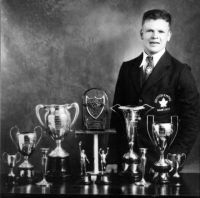
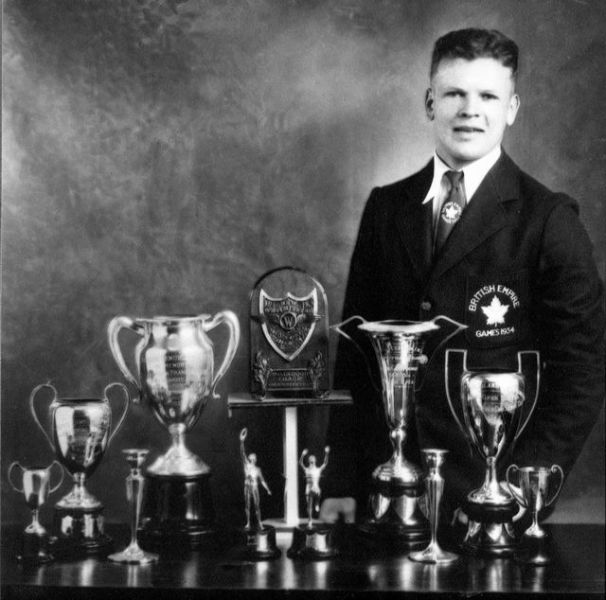
Joe Addison with some of his many trophies. |
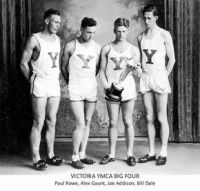
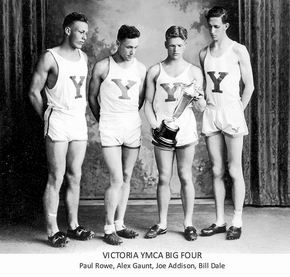
The Big Four. |
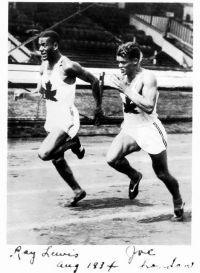
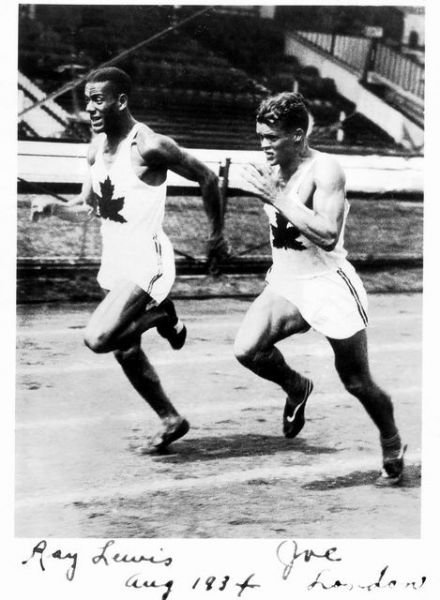
Lewis and Addison. |
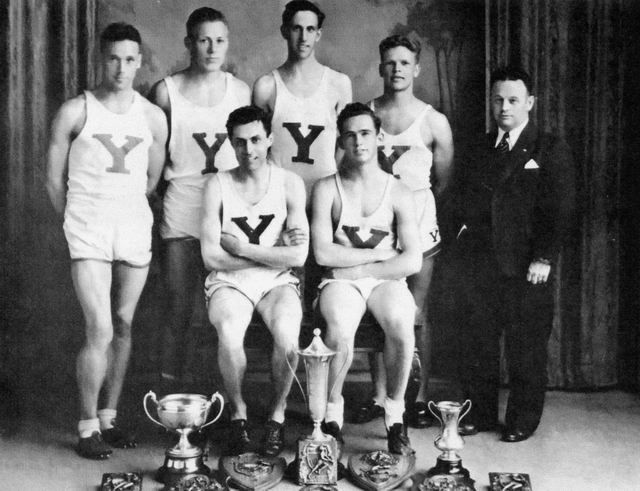
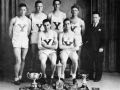
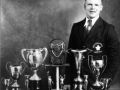
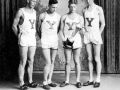
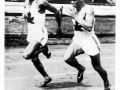
Although the 1930s Victoria Y track teams travelled by bus, streetcars and the midnight boat to Vancouver they were still the talk of the town.
Archie McKinnon, athletic director of the YMCA, wasn't as familiar with track as other sports but by helping out at Victoria High school meets he found new talent to form a competitive Y track team around veteran like one-miler, Charlie Cunningham. Among his first recruits were Lynn Patrick, Art Chapman and Joe Addison, who, since his time as a young athlete in the 1920s, had been labelled "a natural." He would go on to lead the Y's great track team, a predecessor for the Flying Y of 1940s and 50s. A year later, Saanich school sprinters, Noel Morgan and Owen Bentley filled out the team.
1932 was an Olympic year and B.C. began a Young Olympians track and field programme with a goal of preparing young men to represent Canada at the 1936 Olympic Games. Seven local YMCA boys, including, Joe Roberts and Bill Thompson showed up when they collected medals. The following year they were joined by lanky Bill Dale running the half-mile events.
The provincial trials for Canada's 1934 British Empire Games team were held at the new Macdonald Park grass track. Although the locals qualified in each race except the 100 yd. dash, only Addison was amongst the 96 Canadians selected to the BEG team going to London and he came home with a silver relay medal.
By 1935 the Y team had a full house with future Grey Cup champion Paul Rowe joining Bruce Humber in the sprints. Combined with Addison, Dale and Cunningham they had solid teams in the 4x100 and mile relays that gathered trophies throughout the Island and collected seven titles at the B.C. Championships.
Addison, Dale and Humber, who was going to school in Seattle, packed their suitcases and went on to the 1936 Canadian finals in Montreal. Young Bill Dale ran the best race of his life to place second in the 800-metre final at those Olympic Games trials. Humber's sprinting speed won him an invite and a silver medal as Canada's relay team placed second in Berlin.
Unlucky, Addison was distracted in the 400 hurdles and crashed. Rain flooded the track for the 400 and his inside lane was particularly bad. It cost him a team position as only first place athletes received tickets to the Olympics while second and third-place finishers could attend at their own cost. That was too much for Addison and Dale, while McKinnon was surely conflicted as he was picked to coach Canada's track team.
The three "fast friends" wound up their careers as the war began. Joe Addison left the Victoria police force to go overseas where he had the toughest luck of all, dying in a plane crash. Chuck Cunningham slowed down, Gladys caught him and they spent married life coaching and officiating youth softball and basketball in the Cordova Bay area. Bill Dale became the Pacific Coast half-mile champion, won gold and silver medals at the 1938 BEG and was a lifelong YMCA member.
(article courtesy Dave Unwin)
SPONSORED BY THE YMCA-YWCA OF GREATER VICTORIA
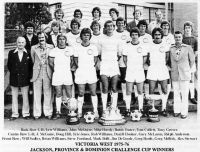
75 / 76 Canadian Champions!! |
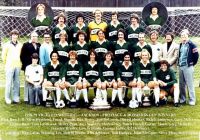
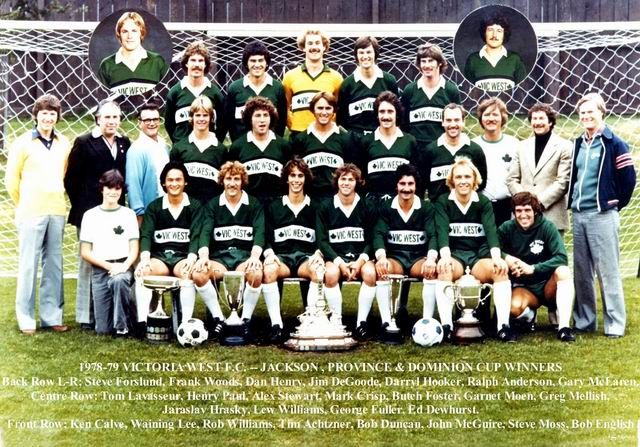
78 / 79 Vic West Soccer Team |
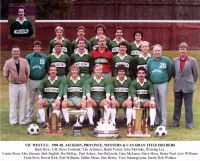
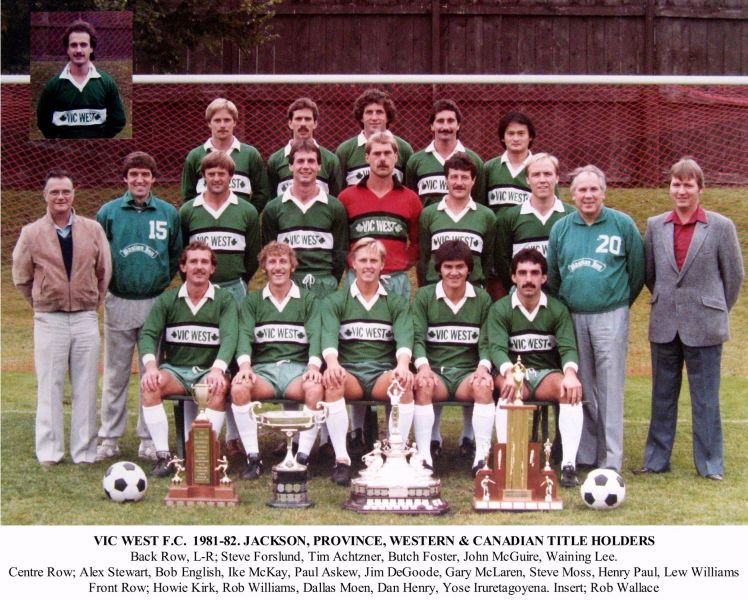
81 / 82 Vic West Soccer Team |
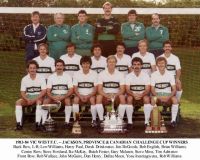
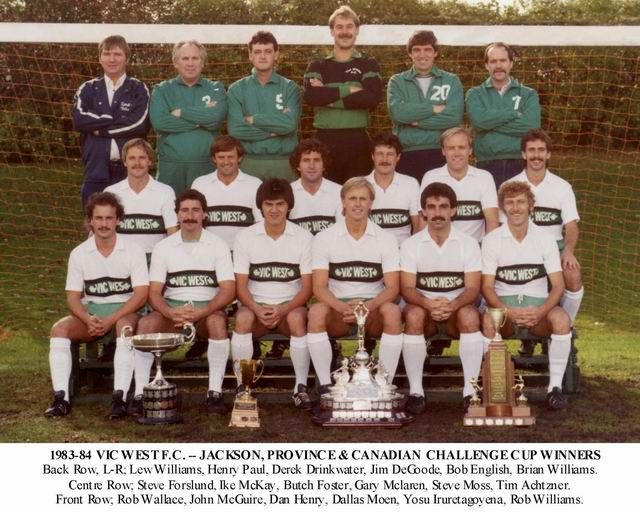
83 / 84 Vic West Soccer Team |
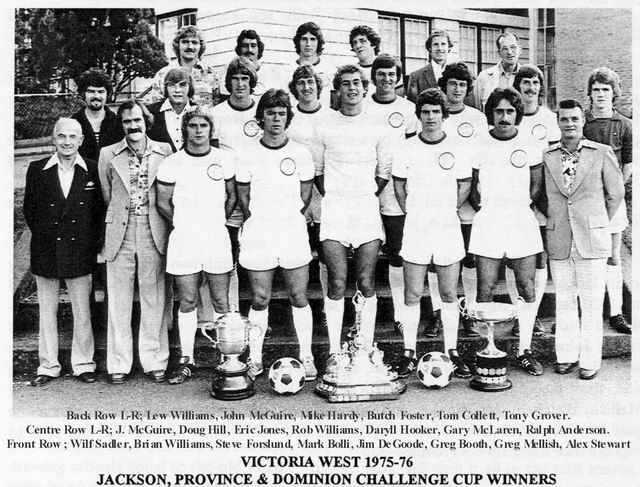
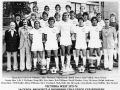
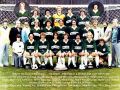
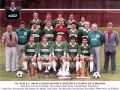
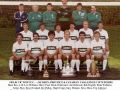
From 1976 to 1984, the Victoria West Soccer Club compiled a Canadian soccer record unequaled by any other club in the nation. At the start of their eighth decade, Vic West assembled a team of good young players that came up through the local minor soccer system, and during that glorious run, they won six BC and four Canadian championships!
By the 1974 season, the Vancouver Island Soccer League had expanded to 40 teams and the league had gained some credibility. Columnist Max Low confirmed that two years after the new alignment, the game was booming and drawing crowds equal to the old Pacific Coast Soccer League. Vic West's coach, George Paul, recruited an entire gang of young Victoria talent including Steve Forslund, Butch Foster, Gary McLaren, Jim De Goode, John McGuire, Rob Williams, and Steve Moss who played together throughout the West's greatest decade. In 1976, Vic Wests won their 16th historic Jackson Cup, and as Vancouver Island Soccer League champions, they went on to defeat the Italia Canadian side to become only the second Victoria club to engrave their name on the Province Cup. The team, coached by Doug Hill, made plans for Winnipeg and the Canadian finals where they beat Fort Rouge in a come -from-behind victory to win the Dominion Challenge Cup.
Vic Wests would do it all again in the 1978-79 season. With Bob English as coach, they beat UVic for the Jackson Cup, trounced Vancouver Croatia for the Province Cup, and then went on to score their second Dominion Challenge Cup by defeating the La Salle Olympiques.
The 1980-81 season saw the Wests defeat the Surrey Firefighters in the Provincial finals for yet another BC crown but they lost to Calgary in a penalty shoot-out after overtime. Their plans for the threepete were dashed.
The next season would be different as Lady Luck smiled on the Wests in their nail-biting defeat of Vancouver Croatia for a fourth BC title. The team went on to beat Winnipeg and Calgary in the Western finals, and then enjoyed a character-building match where they scored four times on Saskatoon United in a howling wind and atrocious field conditions for a third Canadian title.
Butch Foster was the 1983-84 playing coach when they defeated Kamloops for a sixth Province Cup. Victoria hosted the Canadian finals when the Wests won their fourth Canadian title in eight unbelievable seasons -- 1976, 1979, 1983 and 1984. Included in the Vic West's astonishing run were four straight BC titles -- the only team to hold that distinction in the history of the Province Cup, and as the dominant amateur soccer team in Canada, the Wests did it with an unparalleled commitment to teamwork.
SPONSORED BY VICTORIA WEST ATHLETIC ASSOCIATION